Alexbek Learner
The team presented a comprehensive system for addressing Tasks A, B, and C of the LLMs4OL 2025 challenge, which together span the full ontology construction pipeline: term extraction, typing, and taxonomy discovery. Their approach combines retrieval-augmented prompting, zero-shot classification, and attention-based graph modeling — each tailored to the demands of the respective task.
Note
Read more about the model at Alexbek at LLMs4OL 2025 Tasks A, B, and C: Heterogeneous LLM Methods for Ontology Learning (Few-Shot Prompting, Ensemble Typing, and Attention-Based Taxonomies).
Hint
The original implementation is available at https://github.com/BelyaevaAlex/LLMs4OL-Challenge-Alexbek repository.
Overview
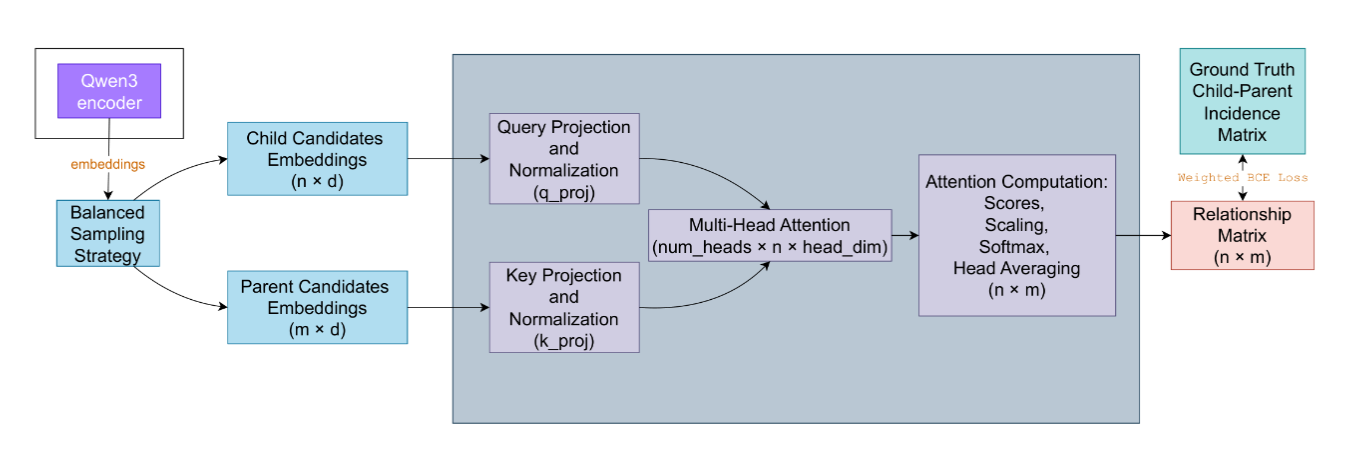
For Task A (Text2Onto), they jointly extract domain-specific terms and their ontological types using a retrieval-augmented generation (RAG) pipeline. Training data is reformulated into a correspondence between documents, terms, and types, while test-time inference leverages semantically similar training examples. This single-pass method requires no model fine-tuning and leverages lexical augmentation. For Task B (Term Typing), which involves assigning types to given terms, they adopt a dual strategy. In the few-shot setting (for domains with labeled training data), they reuse the RAG scheme with few-shot prompting. In the zero-shot or label-scarce setting, they use a classifier that combines cosine similarity scores from multiple embedding models using confidence-based weighting (e.g., via random forests or RAG-style retrieval). For Task C (Taxonomy Discovery), they model taxonomy discovery as graph inference. Using embeddings of type labels, they train a lightweight cross-attention layer to predict is-a relations by approximating a soft adjacency matrix.
Methodological Summary:
Retrieval-Augmented Text2Onto. Training data is restructured into document–term–type correspondences. At inference time, the system retrieves semantically similar training examples and feeds them, together with the query document, into a small generative LLM to jointly predict candidate terms and their types.
Hybrid Term Typing.
Random-Forest Variant. Uses dense text embeddings (and optionally graph-based features from the ontology) as input to a random-forest classifier, producing multi-label type assignments per term.
RAG-Based Variant. Combines a bi-encoder retriever with a generative LLM: for each query term, top-k labeled examples are retrieved and concatenated into the prompt. The LLM then predicts types in a structured format (e.g., JSON), which are parsed and evaluated.
Cross-Attention Taxonomy Discovery. Type labels (or term representations) are embedded using a sentence-transformer model and passed through a lightweight cross-attention layer. The resulting network approximates a soft adjacency matrix over types and is trained to distinguish positive (true parent–child) from negative (corrupted) edges.
Term Typing (Random-Forest)
Loading Ontological Data
For term typing, we use GeoNames as an example ontology. Labeled term–type pairs are extracted and split into train and test sets.
from ontolearner import GeoNames, train_test_split

# Load the GeoNames ontology and extract labeled term-typing data
ontology = GeoNames()
ontology.load()
data = ontology.extract()

# Split the labeled term-typing data into train and test sets
train_data, test_data = train_test_split(
    data,
    test_size=0.2,
    random_state=42,
)
Initialize Learner
Before defining the learner, choose the ontology learning task to perform.
Available tasks have been described in LLMs4OL Paradigms.
The task IDs are: term-typing, taxonomy-discovery, non-taxonomic-re.
task = "term-typing"
We first configure the Alexbek random-forest learner. This learner builds features from text embeddings (and optionally graph structure) and trains a random-forest classifier for term typing.
from ontolearner.learner.term_typing import AlexbekRFLearner

rf_learner = AlexbekRFLearner(
    device="cpu",           # switch to "cuda" if available
    batch_size=16,
    max_length=512,         # max tokenizer length for embedding inputs
    threshold=0.30,         # probability cutoff for assigning each type
    use_graph_features=True # set False for pure text-based features
)
Learn and Predict
from ontolearner import evaluation_report
# Fit the RF-based learner on the training split
rf_learner.fit(train_data, task=task)

# Predict types for the held-out test terms
predicts = rf_learner.predict(test_data, task=task)

# Build gold labels and evaluate
truth = rf_learner.tasks_ground_truth_former(data=test_data, task=task)
metrics = evaluation_report(y_true=truth, y_pred=predicts, task=task)
print(metrics)
Term Typing (RAG-based)
Loading Ontological Data
The RAG-based term-typing setup also uses GeoNames. We again load the ontology and split labeled term–type instances into train and test sets.
from ontolearner import GeoNames, train_test_split

ontology = GeoNames()
ontology.load()
data = ontology.extract()

# Extract labeled items and split into train/test sets for evaluation
train_data, test_data = train_test_split(
    data,
    test_size=0.2,
    random_state=42,
)
Initialize Learner
Before defining the learner, choose the ontology learning task to perform.
Available tasks have been described in LLMs4OL Paradigms.
The task IDs are: term-typing, taxonomy-discovery, non-taxonomic-re.
task = "term-typing"
Next, we configure a Retrieval-Augmented Generation (RAG) term-typing classifier. An encoder retrieves top-k similar training examples, and a generative LLM predicts types conditioned on the query term plus retrieved examples.
from ontolearner.learner.term_typing import AlexbekRAGLearner

rag_learner = AlexbekRAGLearner(
    llm_model_id="Qwen/Qwen2.5-0.5B-Instruct",
    retriever_model_id="sentence-transformers/all-MiniLM-L6-v2",
    device="cuda",      # or "cpu"
    top_k=3,
    max_new_tokens=256,
    output_dir="./results/",
)

# Load the underlying LLM and retriever for RAG-based term typing
rag_learner.load(llm_id=rag_learner.llm_model_id)
Learn and Predict
from ontolearner import evaluation_report

# Index the training data for retrieval and prepare prompts
rag_learner.fit(train_data, task=task)

# Predict types for the held-out test terms
predicts = rag_learner.predict(test_data, task=task)

# Build gold labels and evaluate
truth = rag_learner.tasks_ground_truth_former(data=test_data, task=task)
metrics = evaluation_report(y_true=truth, y_pred=predicts, task=task)
print(metrics)
Taxonomy Discovery
Loading Ontological Data
For taxonomy discovery, we again use the GeoNames ontology. It exposes parent–child relations that can be embedded and fed to a cross-attention model.
from ontolearner import GeoNames, train_test_split

ontology = GeoNames()
ontology.load()
data = ontology.extract()

train_data, test_data = train_test_split(
    data,
    test_size=0.2,
    random_state=42,
)
Initialize Learner
Before defining the learner, choose the ontology learning task to perform.
Available tasks have been described in LLMs4OL Paradigms.
The task IDs are: term-typing, taxonomy-discovery, non-taxonomic-re.
task = "taxonomy-discovery"
Next, we configure the Alexbek cross-attention learner. It uses embeddings of type labels and a lightweight cross-attention layer to predict is-a relations.
from ontolearner import AlexbekCrossAttnLearner

cross_learner = AlexbekCrossAttnLearner(
    embedding_model="sentence-transformers/all-MiniLM-L6-v2",
    device="cpu",
    num_heads=8,
    lr=5e-5,
    weight_decay=0.01,
    num_epochs=1,
    batch_size=256,
    neg_ratio=1.0,
    output_dir="./results/crossattn/",
    seed=42,
)
Learn and Predict
from ontolearner import evaluation_report

# Train the cross-attention model on taxonomic edges
cross_learner.fit(train_data, task=task)

# Predict taxonomic relations on the test set
predicts = cross_learner.predict(test_data, task=task)

# Build gold labels and evaluate
truth = cross_learner.tasks_ground_truth_former(data=test_data, task=task)
metrics = evaluation_report(y_true=truth, y_pred=predicts, task=task)
print(metrics)
Text2Onto
Loading Ontological Data
For the Text2Onto task, we load an ontology (via OM), extract its structured content, and then generate synthetic pseudo-sentences using a direct transformers backend.
import os

# Ontology loader/manager
from ontolearner.ontology import OM

# Text2Onto utilities: synthetic generation + dataset splitting
from ontolearner.text2onto import SyntheticGenerator, SyntheticDataSplitter

MODEL_ID = "Qwen/Qwen2.5-0.5B-Instruct"
HF_TOKEN = os.getenv("HF_TOKEN", "")

# ---- Synthetic generation configuration ----
pseudo_sentence_batch_size = int(os.getenv("TEXT2ONTO_BATCH", "10"))
max_worker_count_for_llm_calls = int(os.getenv("TEXT2ONTO_WORKERS", "1"))

text2onto_synthetic_generator = SyntheticGenerator(
    batch_size=pseudo_sentence_batch_size,
    worker_count=max_worker_count_for_llm_calls,
    model_id=MODEL_ID,
    token=HF_TOKEN,
)

# ---- Load ontology and extract structured data ----
ontology = OM()
ontology.load()
ontological_data = ontology.extract()

print(f"term types: {len(ontological_data.term_typings)}")
print(f"taxonomic relations: {len(ontological_data.type_taxonomies.taxonomies)}")
print(f"non-taxonomic relations: {len(ontological_data.type_non_taxonomic_relations.non_taxonomies)}")

# ---- Generate synthetic Text2Onto samples ----
synthetic_data = text2onto_synthetic_generator.generate(
    ontological_data=ontological_data,
    topic=ontology.domain,
)
Split Synthetic Data
We split the synthetic dataset into train/val/test sets using SyntheticDataSplitter.
Each split is a dict with keys:
documentstermstypesterms2docsterms2types
splitter = SyntheticDataSplitter(
    synthetic_data=synthetic_data,
    onto_name=ontology.ontology_id,
)

train_data, val_data, test_data = splitter.train_test_val_split(
    train=0.8,
    val=0.0,
    test=0.2,
)

print("TRAIN sizes:")
print("  documents:", len(train_data.get("documents", [])))
print("  terms:", len(train_data.get("terms", [])))
print("  types:", len(train_data.get("types", [])))
print("  terms2docs:", len(train_data.get("terms2docs", {})))
print("  terms2types:", len(train_data.get("terms2types", {})))

print("TEST sizes:")
print("  documents:", len(test_data.get("documents", [])))
print("  terms:", len(test_data.get("terms", [])))
print("  types:", len(test_data.get("types", [])))
print("  terms2docs:", len(test_data.get("terms2docs", {})))
print("  terms2types:", len(test_data.get("terms2types", {})))
Initialize Learner
We configure a retrieval-augmented few-shot learner for the Text2Onto task. The learner retrieves relevant synthetic examples and uses an LLM to predict structured outputs.
from ontolearner.learner.text2onto import AlexbekRAGFewShotLearner

text2onto_learner = AlexbekRAGFewShotLearner(
    llm_model_id="Qwen/Qwen2.5-0.5B-Instruct",
    retriever_model_id="sentence-transformers/all-MiniLM-L6-v2",
    device="cpu",          # set "cuda" if available
    top_k=3,
    max_new_tokens=256,
    use_tfidf=True,
)
Learn and Predict
We run the end-to-end pipeline (train -> predict -> evaluate) with LearnerPipeline using the text2onto task id.
from ontolearner import LearnerPipeline

task = "text2onto"

pipe = LearnerPipeline(
    llm=text2onto_learner,
    llm_id="Qwen/Qwen2.5-0.5B-Instruct",
    ontologizer_data=False,
)

outputs = pipe(
    train_data=train_data,
    test_data=test_data,
    task=task,
    evaluate=True,
    ontologizer_data=False,
)

print("Metrics:", outputs.get("metrics"))
print("Elapsed time:", outputs.get("elapsed_time"))